
Apartment & condo intercoms · Toronto & GTA
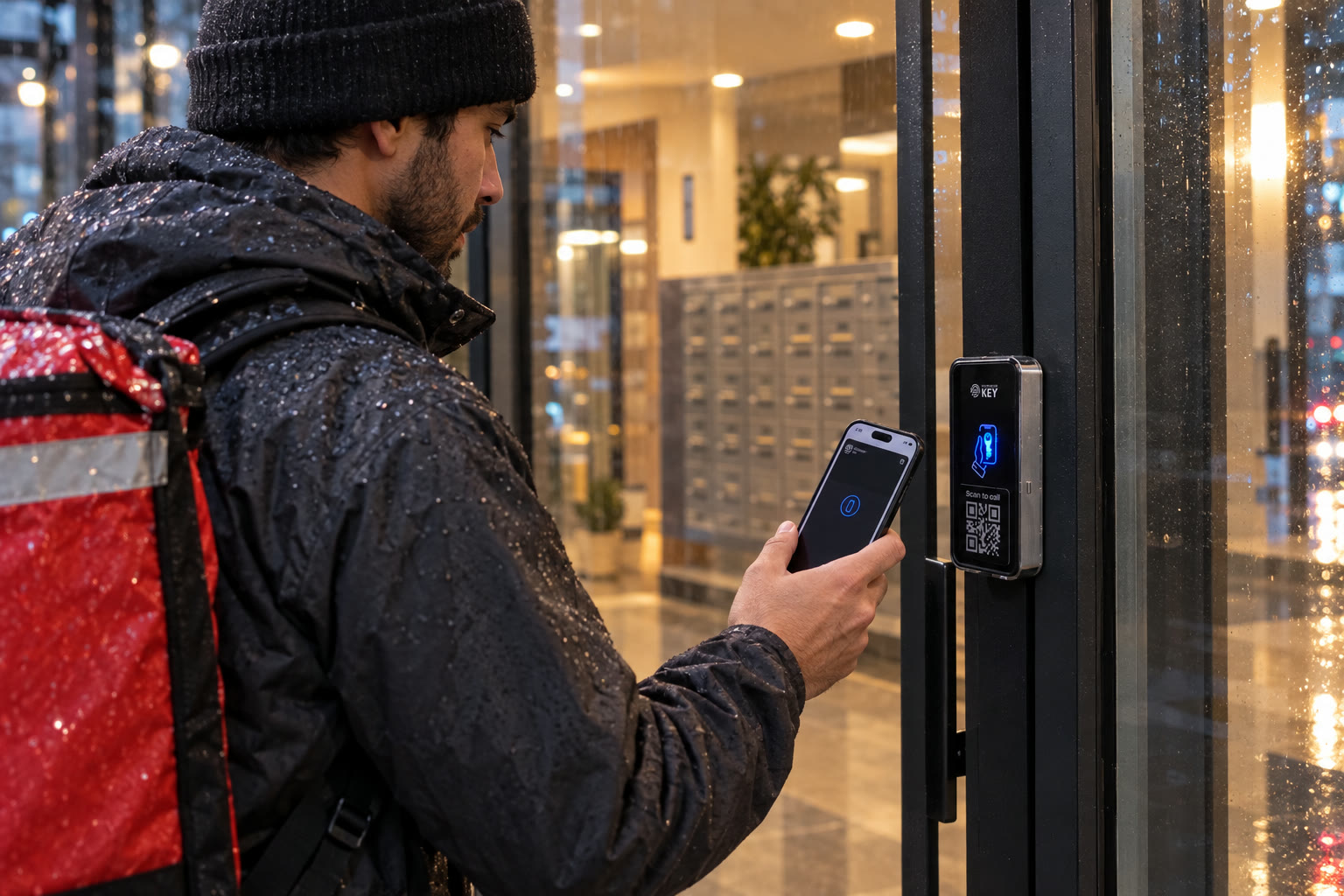
Residents tap in. Visitors scan to call.
Plan resident credentials and visitor calls together at the shared entrance. SmartphoneKey documents Wallet keys, NFC cards and a QR calling route. Management still needs to agree the recipient arrangements, household instructions and assessed lobby work.
Bring the lobby plan to management
What should change for residents and their visitors?
Tell us about the entrance and roughly how many residents. The door check comes first; cost follows.
Bring the building routine
Describe residents, concierge cover and existing visitor equipment.
Review lobby admission
Assess recipient arrangements, shared hardware and property approval.
Agree the resident handover
Include directory changes, visitor instructions and installation costs.
In short
What is an apartment intercom system with phone access?
For property managers, condo boards and building owners
The shared reader can serve documented resident credentials and a visitor calling route. Management must establish the household and recipient arrangements and maintain authorized changes when occupancy changes. Activity records concern credential interactions; they are not independent proof of a resident's physical presence or a complete record of everyone inside the building.
Example, not a completed project
A new household receives instructions while an earlier one leaves.
Picture management arranging incoming lobby credentials and receiving an instruction about an outgoing household. Granting the new permission and reviewing the old access are separate jobs. Explain who performs them and how the incoming residents learn their supported method and visitor routine. This is a sample management transition, not a tenancy record, an automatic software link or authorization to enter another private unit.
A clearer lobby changeover
Plan the household instructions and the continuing management work.
The proposal should identify which common doors change and how the resulting arrangement will be maintained. That makes a reader comparison meaningful to the people relying on the lobby.
Prepare the resident-facing change
- Name the shared openings included in the proposal and the private doors or separate systems outside it. Bring the appropriate building authority into the discussion. A household's wish for an easier arrival does not establish permission to alter the common locking assembly.
- Review supported phone and product-specific card choices without assuming all residents use the same device. Establish how instructions and assistance will be provided. Compatibility with current fobs or indoor equipment needs its own confirmation even when occupants are familiar with their present routine.
- Explain the visitor path with the intended recipients and somebody looking from the lobby side. Include an unanswered arrival and a guest unable to follow the expected phone interaction. An understandable response process should accompany the feature comparison rather than be left for residents to invent after installation.
Prepare the work that continues afterward
- Identify who receives approved move-in, move-out or household-change instructions and who adjusts permission. Initial enrollment is only the start. The documented portal does not demonstrate that an occupancy record elsewhere automatically reaches the person administering the entrance.
- Agree the response to lost or returned credentials and practise the intended administrative operation with an authorized example. Keep the object and its permission distinct. Collecting a card does not independently show whether every associated entitlement has been handled as the building intends.
- Retain the installed opening list, support contacts, continuing costs and administrative responsibilities for future management. Record what was demonstrated and what remains unconfirmed. One resident's successful first entry is useful evidence for that case, not completion of every household and visitor requirement.
Residential entry has several users
Evaluate the lobby from both sides.
The proposal needs to work for the building operator, a resident and a guest who has never seen the entrance. Each sees a different part of the process.
Management owns the common-door decision
Establish the responsible owner, manager or condominium decision-maker. List the equipment included in the proposal and any working arrangement that must remain available during a transition. One occupant’s preference does not establish authority over shared hardware.
Residents need an understood credential
Consider documented Wallet credentials and the product-specific card option. Explain issuing, loss reporting and changes when a household moves. The resident’s access to the lobby should not automatically include another unit or a restricted service room.
Guests need a usable request route
Review the QR calling method and how the intended recipient is identified. Include residents and visitors who cannot use the expected phone interaction. Ask management to assess the real arrival instructions rather than only the appearance of a replacement panel.
Administrators need timely information
Moving households and changing contractors require updates to permission. Assign the person who receives those changes and the person who acts in the portal. A management feature does not create an occupancy notification process on its own.
The source guides document resident credential options, QR calling and administration. Household-change examples here organize management questions; they do not establish automatic tenancy updates, local customer installations or approval of an unassessed common entrance.


Review the entrance as a shared service
Include management, maintenance and the resident experience.
Show the existing lobby release and calling equipment with the responsible property contact. Explain how residents enter now and how guests reach them. Review supported credential choices and the instructions households would need after a change. The proposed arrangement must connect those operating needs to the actual door, power, connection and approval boundaries; the purchase of a reader does not settle them by itself.
Is it the right fit?
Can the building own the changeover and later access decisions?
Useful when common-door responsibilities are clear
- The building turns over residents and fobs keep going missing.
- You want visitors to call from the door without a wired panel.
- The board, owner or manager can approve the entrance change.
Confirm essential equipment and synchronization needs
- You need a voice panel with a button for every unit.
- Access must sync from another property system. That isn’t confirmed.
Before residents learn a different arrival method
Explain the change and who keeps it current.
A lobby proposal needs to make sense from outside the building and from the administrator's desk. Keep the household boundaries clear in both views.
Can a visitor use an apartment handset already installed upstairs?
That compatibility has not been established for an unidentified building system. SmartphoneKey documents a QR-and-phone calling route. Compare the actual proposed recipient experience before making promises about retained indoor equipment.
Are current resident fobs guaranteed to work?
No universal reuse is promised. The product documents its own NFC cards. Assessment must determine whether another credential system is retained separately, replaced or involved in a specifically supported arrangement.
Who changes access after a household leaves?
Management needs an assigned process for reporting the change and an authorized administrator to remove permission. Revocation capability does not mean the reader knows about a move-out before anyone reports it.
Can the lobby be upgraded by a unit resident?
Bring the responsible building decision-maker into the enquiry. A resident may gather information, but shared-door alterations require the appropriate authority. Keep the private-unit entrance and common lobby scopes distinct.
What privacy discussion should happen with residents?
Explain administrative visibility and how the building intends to use activity records. Camera permissions, if used, deserve their own role decisions. An entry event should not be described as a complete account of a household’s whereabouts.
How is entry handled if power or a phone fails?
The installed equipment and the resident’s credential are different parts. Establish the lock’s outage behaviour, safe exit and an actual authorized fallback. A card alternative alone does not prove every equipment failure has been addressed.
What should residents learn before the arrival method changes?
Explain the affected entrance, supported credential choices, visitor route and assistance contact. Management should agree how and when those instructions are provided once the proposed work is understood. The feature list alone does not show that every household knows which reader to use or whom to contact when an intended method is unavailable.
Should a common-lobby key automatically cover private-unit doors?
No such permission should be inferred. Identify the actual common openings included and the authority controlling each one. A private-unit arrangement can have another owner and hardware scope. Keep the user's authorized route explicit instead of treating one building credential as a reason to grant every door within it.
Next step
Start with the lobby door.
Tell us about the entrance and roughly how many residents. The door check comes first; cost follows.
Request a door checkCompare the common-door scope and resident handover
List retained equipment, proposed release and reader work, supply and connectivity. Include resident credential choices, visitor instructions, administrative handover and ongoing package charges. An unconfirmed old-fob or handset relationship should remain visible rather than be implied by the word intercom.
For the Toronto/GTA building review, coordinate the responsible management and maintenance contacts and access to relevant equipment. Discuss household instructions and any proposed interruption after assessment. This demonstration form sends no announcement and books no lobby changeover.